Imagine your competitors increasing productivity by 30% and bringing products to market faster not by hiring more people or expanding production capacity, but by deploying AI agents.
AI agents help automate repetitive tasks, unlock insights from enterprise data, and support decision-making, allowing engineers to focus more on innovation rather than manual activities. From software development and field service operations to supply chain management, AI agents are delivering significant improvements in productivity, speed, and operational efficiency while reducing costs.
In addition, Generative AI enables users to interact with industrial data using natural language, making information easier to access, analysis more effective, and decision-making more informed. As multiple AI agents collaborate across different enterprise systems, organizations can build an intelligent operational network that spans the entire value chain.
In the next phase of digital transformation, manufacturers will move beyond digitizing data to leveraging Digital Intelligence where AI agents can advise, assist, and automate core business processes. This shift will help companies strengthen their competitive advantage, accelerate innovation, and drive greater business value.
.jpeg)
Source: PTC
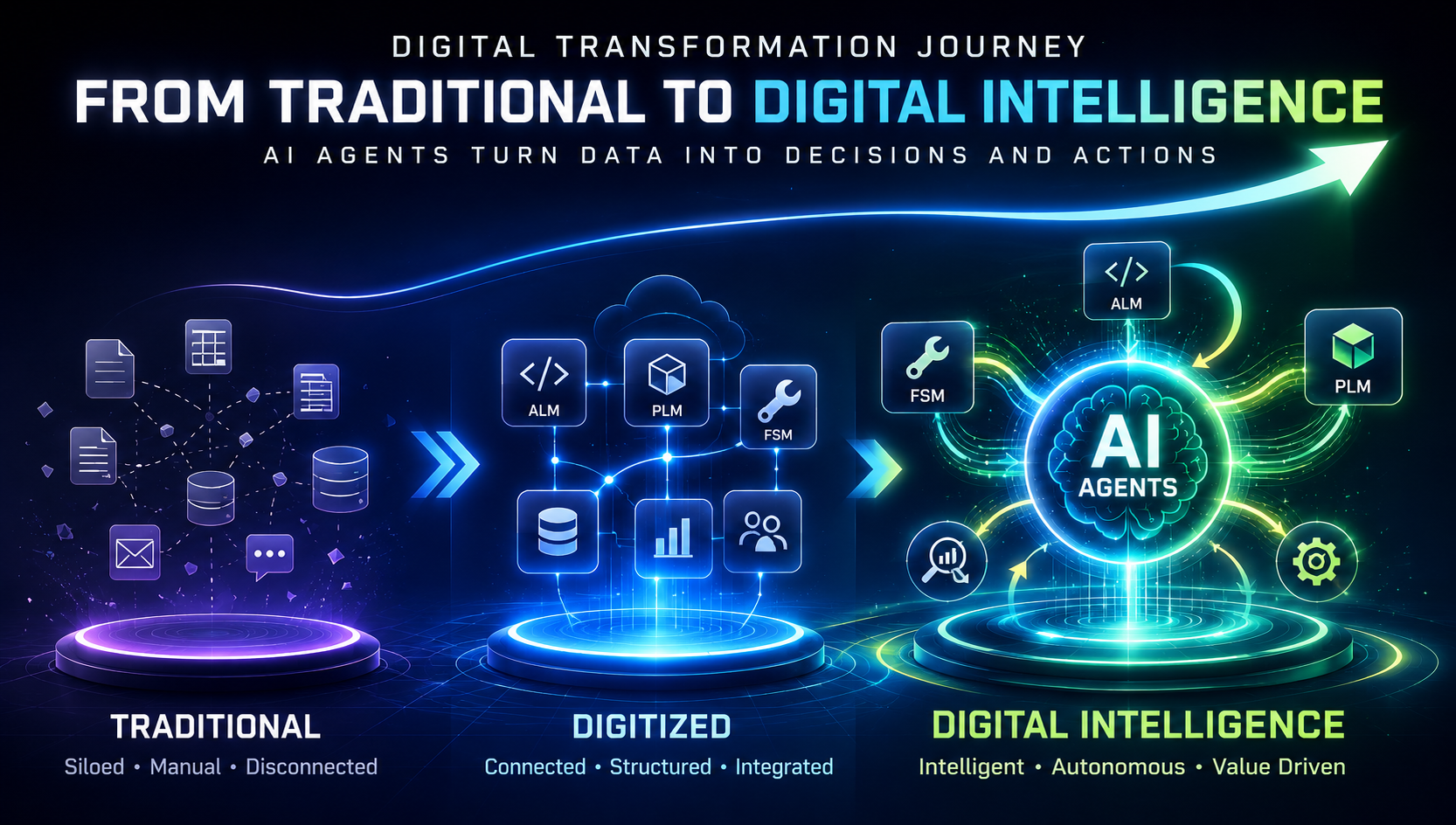
In the initial stage, data and workflows exist in silos, represented by the scattered green dots. Each department uses its own tools, and data is not effectively connected across functions. Product development management relies heavily on manual processes, communication through emails and spreadsheets, or isolated systems. As a result, information is fragmented, collaboration is limited, and overall efficiency remains low.
During the digitization stage, data and workflows are moved into enterprise software systems. The boxes in the diagram represent platforms such as ALM, PLM, CAD, FSM, and other specialized management systems. Data is stored in a more centralized manner, while systems become connected and capable of sharing information, improving collaboration across departments.
However, at this stage, software primarily serves as a tool for storing, managing, and transferring data. People remain responsible for analyzing information, making decisions, and taking action.
Digital Intelligence represents the next stage in the evolution of digital transformation. In addition to having digitized data and connected systems, organizations introduce an AI intelligence layer at the center of the ecosystem, represented by the brain icon in the diagram.
AI agents can access data from multiple systems, understand business context, analyze information, reason, and proactively recommend or execute actions. Rather than simply storing data, the system can now support decision-making and automate business processes.
For example, an AI agent can analyze service data from an FSM system to identify recurring product issues, automatically update requirements in an ALM system, and trigger an engineering change process in a PLM system when necessary. Through seamless connectivity and coordination across systems, data is transformed into action, enabling companies to improve product quality and accelerate continuous improvement.
Digital transformation does not end with digitizing data. The ultimate goal is to build an intelligent software ecosystem where AI agents can leverage data across the entire value chain to support and automate product development activities.


