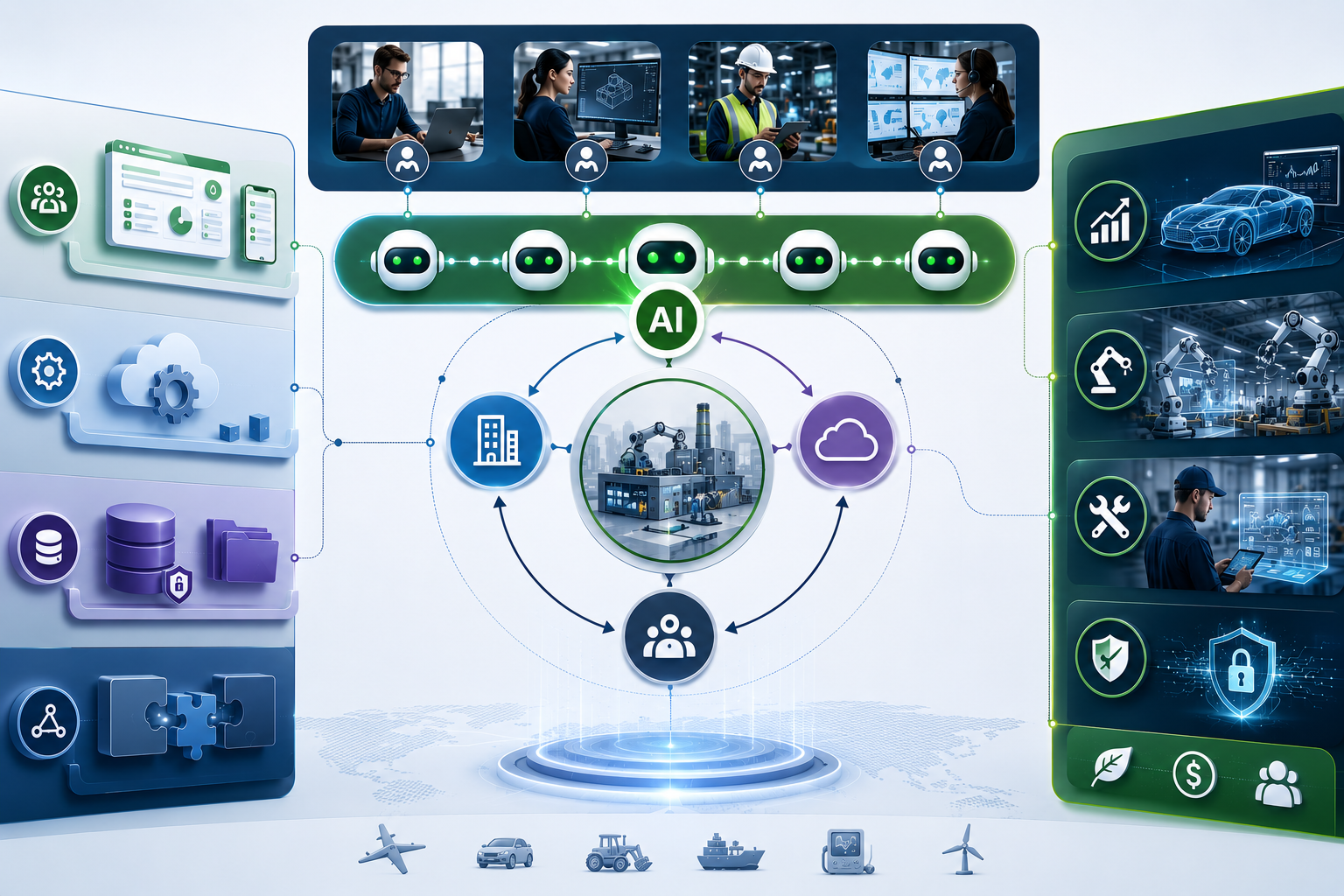
Digital Intelligence is ushering in the next phase of digital transformation in the manufacturing industry. The foundation of this transformation is built upon enterprise software systems such as ALM, PLM, CAD, and FSM, combined with an intelligent technology layer powered by AI Agents.
Over the past decade, PTC has continuously incorporated AI into its solutions, ranging from predictive analytics in ThingWorx and design optimization in Creo to Machine Learning applications in Servigistics and Computer Vision capabilities in Windchill. Today, PTC is further advancing its AI strategy by integrating AI Agents and Generative AI into products such as ServiceMax and Codebeamer to enhance automation and support better decision-making.
To effectively deploy AI Agents in enterprise environments, the technology platform is structured around four key layers: User Engagement, Application Services, Data Management, and the Software Ecosystem. The integration of these technology layers enables organizations to move beyond simple data digitization and unlock the power of Digital Intelligence—transforming data into actionable insights and measurable business value.
.jpeg)
Source: PTC
AI agents do not operate in isolation. They depend on a broader software ecosystem to access data, execute tasks, and deliver business value. Three key stakeholders within this ecosystem are Independent Software Vendors (ISVs), hyperscale cloud providers (hyperscalers), and manufacturers.
As AI agents become increasingly prevalent in enterprise software, ISVs will adopt multi-agent architectures both within their own software portfolios and across different software ecosystems.
The typical maturity journey for ISVs begins with embedding AI agents into individual software applications, such as PTC’s CAD and PLM solutions. Once this stage is achieved, two primary paths emerge:
In some cases, internal portfolio integration offers significant strategic value. For example, leveraging the existing connections between Creo and Windchill can help design engineers work more efficiently and make better-informed decisions.
In other situations, organizations may prioritize integrating Windchill PLM with external ERP and MES solutions to support critical downstream manufacturing operations. The optimal integration strategy depends on the specific business objectives, workflows, and value-creation opportunities within the enterprise.
Source: PTC
In every integration scenario, high-quality APIs, governance frameworks for AI oversight, and business models for agent usage will be essential for both Independent Software Vendors (ISVs) and manufacturers.
Hyperscalers provide the essential AI services and infrastructure that AI agents rely on, including computing power, AI model hosting and deployment services, and enterprise-scale solutions.
For example, Microsoft currently offers more than 1,800 large language models (LLMs), provides a comprehensive AI and data platform through Microsoft Fabric, and is developing industry-specific knowledge graphs, such as the Manufacturing Data Solutions initiative for the manufacturing sector.
This is one of the key reasons why PTC has chosen to establish a strategic partnership with Microsoft, leveraging its advanced AI infrastructure and extensive ecosystem of AI services, which can operate at scale while maintaining strong security and reliability.
In addition, we view the AI adoption journey as a collective effort, where technology sharing and the exchange of best practices play a critical role in helping manufacturers successfully implement, scale, and realize value from AI across their operations.
Manufacturers sit at the center of the AI ecosystem, serving both as users and developers of AI solutions.
By adopting AI, manufacturers can accelerate product development and strengthen their competitive advantage. They focus on the highest-value use cases to maximize the return on their AI investments while also influencing market direction and shaping the development priorities of both ISVs and hyperscalers.
As users, manufacturers leverage specialized AI solutions to generate business value quickly. As developers, they build their own AI agents and apply governance, integration, and scalability principles to ensure these agents operate effectively across the enterprise.
In summary, a robust software ecosystem is essential for AI agents to realize their full potential. It enables them to integrate seamlessly with software systems, operate on the powerful and reliable infrastructure provided by hyperscalers, and deliver tangible business value to manufacturers.
More broadly, these are the core building blocks of an AI agent-powered technology platform. With their ability to be deeply embedded into business processes, act intelligently, and collaborate across systems, AI agents are becoming a powerful force for transformation. As a result, many industry experts believe that AI agents will soon become a ubiquitous component of enterprise software.


