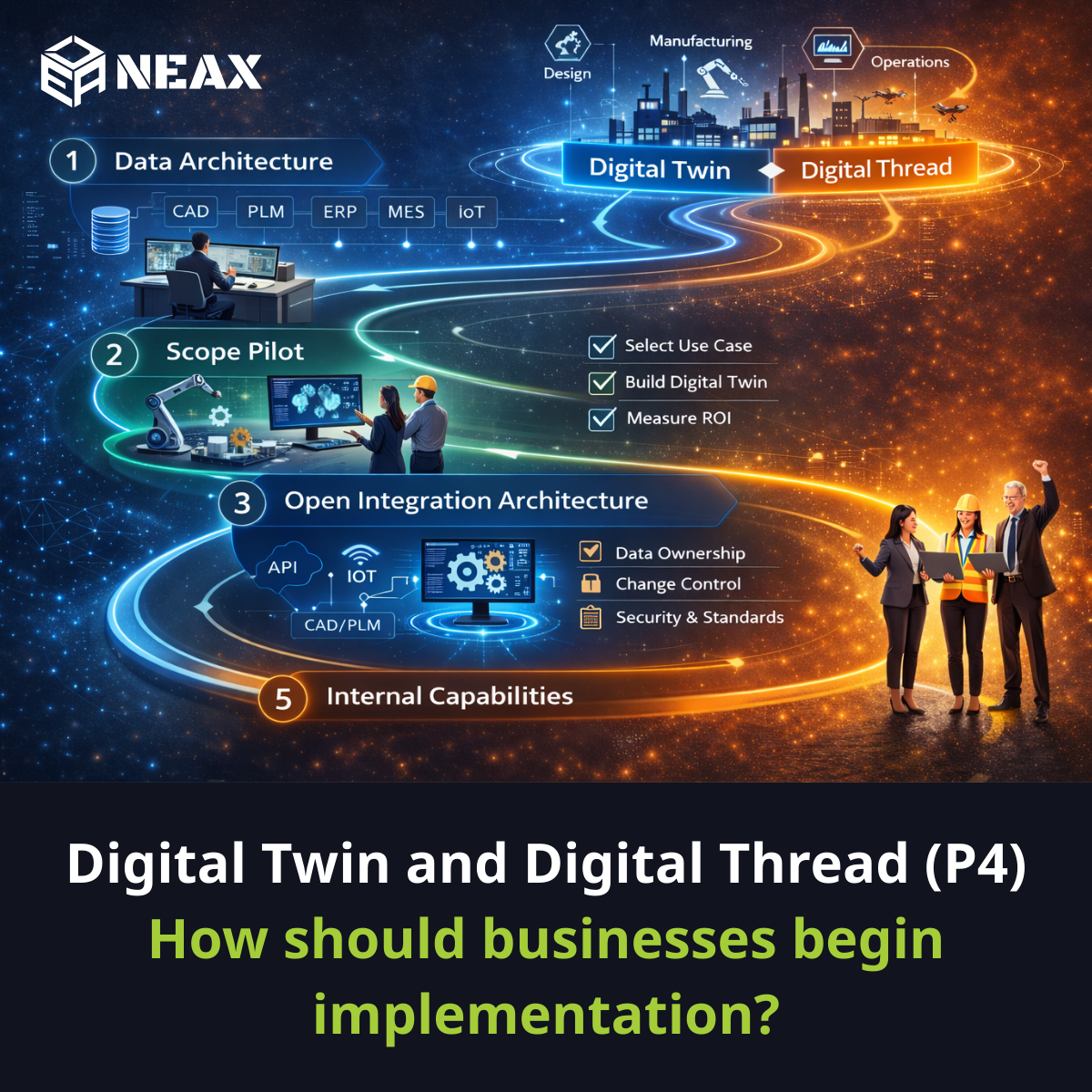
The implementation of Digital Thread and Digital Twin should not start with technology, but with strategy and clearly defined business challenges. Organizations need to identify their top priorities: reducing downtime, shortening time-to-market, optimizing maintenance, or enhancing configuration traceability. Defining the right use case from the outset helps avoid fragmented investments and ensures measurable ROI from the early stages of deployment.
Review existing systems such as CAD/CAE, PLM, ERP, MES, and IoT platforms. Organizations need to identify data silos, evaluate BOM synchronization levels, assess version control practices, and examine change management processes. If the data foundation is not yet mature, it is advisable to prioritize building a Digital Thread to ensure data consistency before advancing further.
Avoid deploying across the entire enterprise from the outset. Instead, select a production line, a specific product, or a critical asset to develop a pilot Digital Twin model. A phased implementation approach helps manage risk and demonstrate tangible results before scaling.
Implementation should be based on API-driven or event-driven integration architecture to ensure future scalability. The Digital Thread must be capable of connecting multiple systems, while the Digital Twin requires a stable and secure real-time data acquisition infrastructure.
The Digital Thread is only effective when data is standardized and tightly managed. Organizations must clearly define data ownership, change control procedures, access rights, and configuration naming standards.
Successful implementation is not just about software—it requires a shift in operational mindset. Engineering, IT, and production teams must be trained in data architecture, configuration management, and digital model analytics.
When implemented correctly, organizations can move from fragmented digitization to an intelligent, data-driven operating architecture—rather than merely investing in isolated simulation tools or disconnected system integrations.
.png)
Implementing Digital Twin and Digital Thread is not a standalone IT project; it is a strategic decision that shapes how an organization operates for years to come. What truly matters is not adopting the latest technology, but building a robust data architecture capable of supporting sustainable growth, risk control, and performance optimization.
Organizations that start the right way will not only reduce downtime or improve productivity, but also create an ecosystem where design, manufacturing, and operations are connected in a continuous loop. When data is standardized, digital models become reliable; when models are accurate, managerial decisions become faster and more confident.
The transition from fragmented digitization to intelligent, data-driven operations does not happen overnight. However, each strategic step brings the organization closer to becoming a truly smart factory where data is not merely stored, but leveraged to generate long-term competitive advantage.


